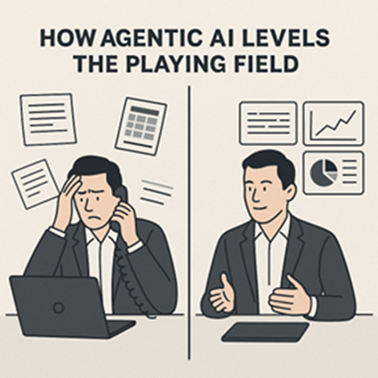
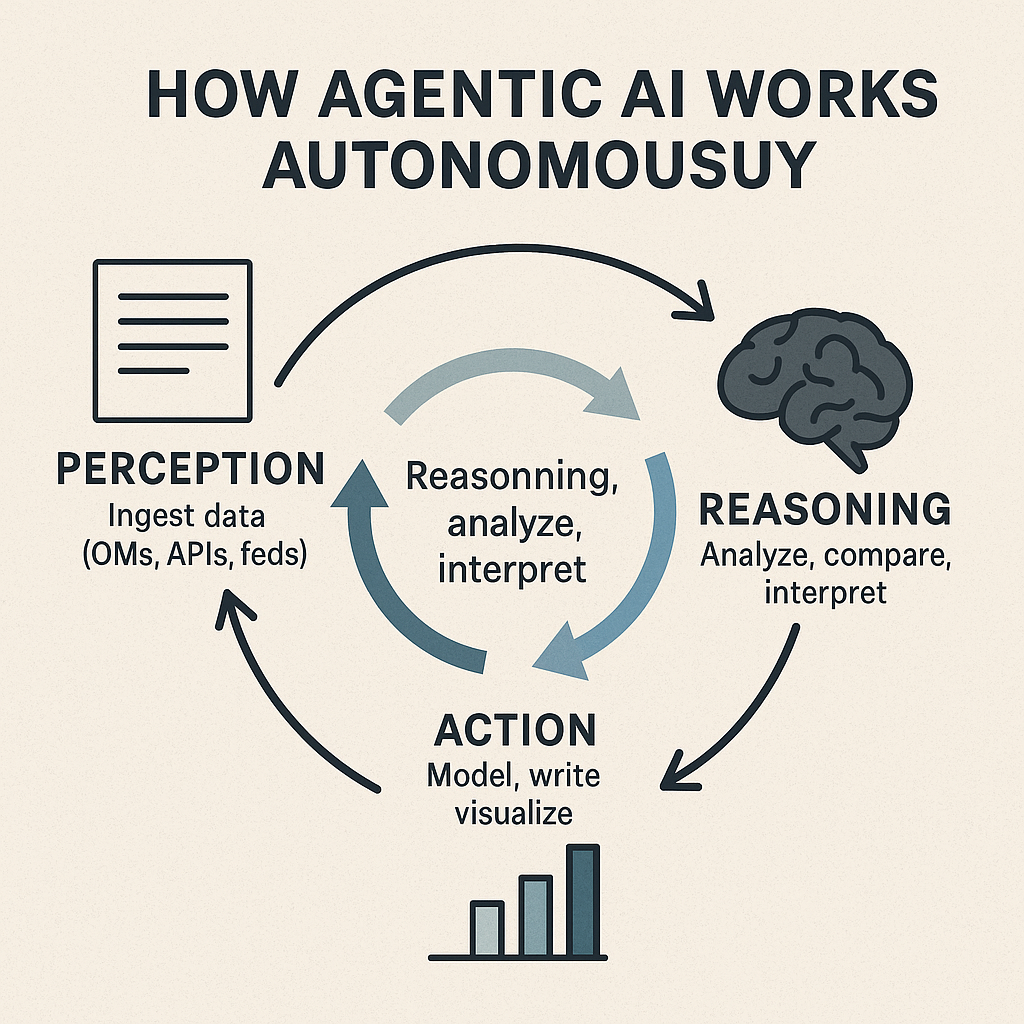
Keeping up with the latest trends in AI is extremely challenging today, as new products and product improvements emerge weekly. One way I stay up to date is by listening to the podcast “The Daily AI Brief” with host Nathaniel Whittemore. In the post that follows, I have distilled some of Nathaniel’s research on “agentic” AI and workflow agents into a concise and actionable summary that you can apply today. You can access the podcast here: https://www.youtube.com/watchv=4NITt8iQxCA&list=PLRYSuzHGhXPmKnOpd-f588cNNmTe2S9FP&index=9
The Agentic Era: Unlocking Transformative Potential with AI Agents
Welcome to the forefront of artificial intelligence, where the conversation has shifted from mere productivity tools to something far more profound: agent transformation. We are, in essence, entering the “agentic era”, a period where AI agents are fundamentally changing the equation on the amount and type of work individuals and organizations can accomplish as a whole. The agentic era isn’t just about making tasks easier; it’s about unlocking entirely new capabilities and reshaping workflows at an unprecedented scale.
The statistics underscore this rapid evolution: the most recent KPMG pulse survey revealed a massive increase in full enterprise agent deployments, tripling from 11% to 33% between Q1 and Q2. This increase follows a significant jump in pilots from 37% to 65% between the fourth quarter and the first quarter of the year. A staggering 90% of organizations surveyed by KPMG have now moved past AI agent experimentation, actively engaging in either pilots or full deployments. This progress isn’t a futuristic concept; agents are here, and they are happening right now.
Agents vs. Assistants: A Crucial Distinction
Before delving into the diverse world of AI agents, it’s essential to clarify what distinguishes them from other forms of AI, such as assistants or co-pilots. While hyper-specific technical definitions can often complicate understanding, the practical intuition shared by business professionals is the most useful dividing line. As one might put it:
- Assistants are AI that I use to do things. Think of your co-pilot as a highly skilled tool that assists you in your tasks, awaiting your direct command.
- Agents are AIs that do things for me. Agents are designed to take initiative, execute tasks, and achieve goals with a degree of autonomy, often without requiring constant human intervention.
This distinction is crucial because it highlights the shift from AI as a reactive tool to AI as a proactive, autonomous worker within an organization.
Two Lenses for Understanding AI Agents: Functionality and Focus
To effectively plan your personal or organizational agent strategy, it’s beneficial to understand the various types of agents that exist. Broadly speaking, AI agents are categorized in two primary ways:
- Based on their functionality (how they operate). This framework delves into the internal mechanisms and decision-making processes of the agent.
- Based on their focus (the output or business goal they aim to achieve). This perspective helps businesses understand the practical applications and outcomes of deploying agents.
Each of these categorization methods typically includes seven subcategories, providing a comprehensive view of the agent landscape.
Understanding Agents by Functionality: How They Operate
When we look at agents through the lens of their operational mechanics, we often encounter a list of six or seven distinct types. This framework helps us understand what’s “under the hood” and how agents interact with data in the world. Here’s a breakdown of these functional agent types:
- 1. Simple Reflex Agents
- Core Mechanism: These agents operate based on predefined rules and immediate data.
- Key Characteristics: They react directly to current perceptions, following an “event-condition-action” rule.
- Limitations: They do not respond to situations beyond their programmed rules and cannot remember past states.
- Best Suited For: Straightforward tasks that don’t require extensive training or complex decision-making.
- Examples: Automated sprinkler systems that activate based on smoke detection, email autoresponders that send predefined messages for specific keywords, or an agent that resets passwords by detecting particular keywords in a user’s conversation.
- 2. Model-Based Reflex Agents
- Core Mechanism: These are more sophisticated reflex agents that possess an advanced decision-making mechanism capable of evaluating probable outcomes and consequences before taking action.
- Key Characteristics: They use an internal “world model” to understand how the environment evolves, allowing them to infer unobserved aspects of the current state and make better decisions.
- Note: Although they utilize a model, they still don’t “remember” past states in the same way more advanced agents do.
- Example: Network monitoring systems that rely on metrics, logs, events, and network metadata to understand overall network conditions, detect anomalies, route alerts, and assist with root cause analysis.
- 3. Goal-Based Agents
- Core Mechanism: Unlike reflex agents, goal-based agents can plan sequences of actions to achieve desired outcomes. They aren’t just reacting; they are strategizing to accomplish a specific “goal state.”
- Key Components: Their architecture typically includes a goal state, a planning mechanism, state evaluation, action selection, and a world model.
- Example: An inventory management system that can plan reorder schedules to maintain target stock levels. This process involves understanding the current stock, the desired stock, and lead times, and then planning actions (such as orders) to bridge the gap.
- 4. Utility-Based Agents
- Core Mechanism: These agents build upon goal-based agents by being able to explore and handle trade-offs between competing goals. Rather than simply aiming for a specific state, they optimize for multiple benefits simultaneously.
- Key Differentiator: They can weigh different factors and make decisions that maximize overall “utility” or satisfaction, even without prior knowledge of which priorities the end-user will value most.
- Example: An agent that searches for flight tickets, balancing competing factors like minimum travel time versus price, without being explicitly told which is more important. It seeks the best overall compromise.
- 5. Learning Agents
- Core Mechanism: These agentic systems are capable of improving their behavior over time by learning from previous experiences.
- Key Differentiator: Instead of relying solely on pre-programmed knowledge, they can determine how to achieve goals through ongoing interaction and experience. This approach allows for continuous adaptation and improvement.
- Example: An advanced customer service chatbot that improves its responses and effectiveness based on the ongoing conversations it has with customers, learning from successes and failures.
- 6. Hierarchical Agents
- Core Mechanism: These are complex agentic systems in which higher-level agents decompose complex tasks into smaller ones and then assign these subtasks to lower-level, specialized agents.
- Key Characteristics: Each subordinate agent works independently and reports its progress back to the supervising agent. The higher-level agent collects results and coordinates the subordinates to ensure the collective achievement of the overall goal.
- Advantage: This structure enables the tackling of far more complex goals by breaking them down into manageable, specialized subtasks, thereby leveraging the strengths of different agents.
- 7. Multi-Agent Systems
- Core Concept: Although sometimes listed as a distinct type, multi-agent systems combine various agents working together to achieve complex goals. This reference emphasizes the collaborative aspect of agents.
- Significance: This framework highlights how different types of agents (e.g., a learning agent, a goal-based agent, and a simple reflex agent) can cooperate within a larger system to solve problems that no single agent could address on its own.
Understanding Agents by Focus: Business Outcomes and Archetypes
While the functional frameworks explain the “under the hood” operations, understanding agents based on their focus, or the output and business goal they aim to achieve, is beneficial for businesses. This categorization focuses on how humans are deploying agents and the types of outcomes they deliver. “The Information” article highlights several key archetypes:
- 1. Business Task Agents
- Purpose: The design of these agents is for straightforward yet highly repetitive and common business use cases.
- Examples Include Data entry, document classification, invoice processing, and a significant portion of current business process automation. These are the workhorses handling routine, high-volume tasks.
- 2. Conversational Agents
- Purpose: Focused on interaction, these agents handle both external-facing customer service and internal-facing support.
- Examples Include Customer service chatbots, virtual assistants for IT support, and HR query resolution. They streamline communication and provide immediate assistance.
- 3. Research Agents
- Purpose: As the name suggests, these agents are adept at gathering and synthesizing information.
- Significance: They are significant for the average employee, often being one of the first “agentic experiences” that even non-technical individuals are deploying to considerable effect. They can significantly reduce the time spent on information retrieval.
- 4. Analytics Agents
- Purpose: These agents are specialized in analyzing structured data to produce meaningful insights.
- Outputs: They can generate graphics, charts, or comprehensive reports from raw data, transforming data into actionable intelligence.
- 5. Developer Agents
- Purpose: A major breakout category, developer agents are focused on assisting with coding and software development tasks.
- Impact: This has been a significant theme this year, with “coding assistant” being the most common internal use case (77%) for organizations producing AI or agent software. They boost developer productivity and efficiency.
- 6. Domain-Specific Agents (Vertical Agents)
- Purpose: These are highly specialized agents that possess particular domain knowledge.
- Examples: Agents tailored for the legal, healthcare, or finance industries, understanding the nuances, terminology, and regulations unique to those fields. This deep expertise allows them to perform highly specialized functions.
While “The Information” article highlights six specific types within the “focus” category, the podcast suggests “seven categories” for focus-based agents. Mr. Whittmore explicitly lists “Business Task, Conversational, Research, Analytics, Developer, and Domain Specific agents,” which are six categories, implying that there might be a seventh, or a broader interpretation of one of these categories. This slight discrepancy in the number of listed focus-based types doesn’t detract from the utility of this categorization method for understanding business outcomes.
KPMG’s TACO Framework: An Intuitive Alternative
In addition to the seven functional and seven focus-based categories, KPMG offers a more intuitive, simplified functional breakdown known as the TACO Framework. This framework categorizes agents into four categories, distinguishing them by the complexity of tasks they undertake, the level of human involvement required, and the scope of systems with which they can interact.
- Taskers: These agents execute well-defined individual tasks and typically require a human in the loop for oversight or initiation. They are the most basic form of automation.
- Automators: Moving up in complexity, automators can manage more complex tasks that span multi-system workflows. They handle sequences of actions across different platforms.
- Collaborators: These are adaptive AI teammates that manage multi-dimensional goals. They are more autonomous and can work alongside humans, adjusting their approach as objectives evolve.
- Orchestrators: The pinnacle of this framework, orchestrators are transformative agentic systems that coordinate multiple agents and tools to manage interdependent workflows. Orchestrators oversee and manage entire ecosystems of interacting agents and other systems.
The TACO framework is beneficial for non-technical audiences due to its intuitive terminology.
The Future is Orchestration: Building Comprehensive Agent Systems
A clear trend is emerging in the industry, especially within enterprises and private equity firms, with a massive emphasis on orchestrators and multi-agent systems. The full value of AI agents will not come from “single-shot agents” operating in isolation. Instead, it will be realized when agents work together in comprehensive, complex digital worker organizations.
This vision of interconnected agents is why companies like Microsoft, at their Build Conference, focused heavily on software and agent infrastructure, including multi-agent orchestration in Co-pilot Studio. The goal is to enable the deployment of more comprehensive and complex agentic systems, where agents can interact with one another. Frameworks supporting agent-to-agent interaction, such as the ATA (Agent-to-Agent) communications protocol, further highlight this direction.
Thinking in terms of these “systems” is critical because if agents are truly going to take on significant chunks of labor or enable functions previously impossible due to complexity or cost, they must work together in coordinated systems. Organizations that anchor their thinking and system design to this agent system’s future will be more productive and directionally aligned with where the world is heading.
Agent Readiness: The Importance of Infrastructure
To truly unlock the potential of AI agents, organizations must consider the necessary infrastructure and technology stack to support them. This “agent readiness” goes beyond just identifying use cases; it involves a comprehensive approach to the underlying technology. Key areas of infrastructure and tools include:
- Model Training and Fine-tuning
- LLM and AI Application Development
- Monitoring and Observability (Nearly 100% of organizations interacting with agents will need this)
- Inference Optimization (Common across almost everyone)
- Model Hosting and Evaluation
- Data Processing and Feature Engineering
- Vector Databases
- Synthetic Data and Data Augmentation
- Coding Assistance, DevOps, and MLOps50
- Product and Design Tools
While not every enterprise will need to deal with every single one of these areas, many are common necessities for anyone interacting with agents. Investing in this infrastructure is as crucial as identifying the agent use cases themselves.
Your Agentic Journey Starts Now
The reality is clear: agents are here, and they are distinctly not monolithic. These agents represent a broad set of different capabilities and operational models. Understanding these operational models and identifying which focus areas will be most useful for your specific needs is a key part of your work in the years to come.
Whether you’re exploring single-shot agents or beginning to design complex multi-agent systems, grasping these distinctions is foundational. The agentic era promises to transform how we work, innovate, and achieve organizational goals, and being prepared means understanding the diverse nature of the AI agents that will drive this change. The journey is just beginning, and equipping yourself with this knowledge is your first crucial step into this exciting new era.